1. Introduction
The expansion of oil palm (Elaeis guineensis Jacq.) plantations into peatlands in Indonesia and Malaysia faces stark biophysical challenges compared to mineral soils. Tropical peatlands (Histosols) are classified as marginal soils because they consist of partially decomposed organic matter with a very low mineral content (<12%) [Agus & Subiksa, 2008].
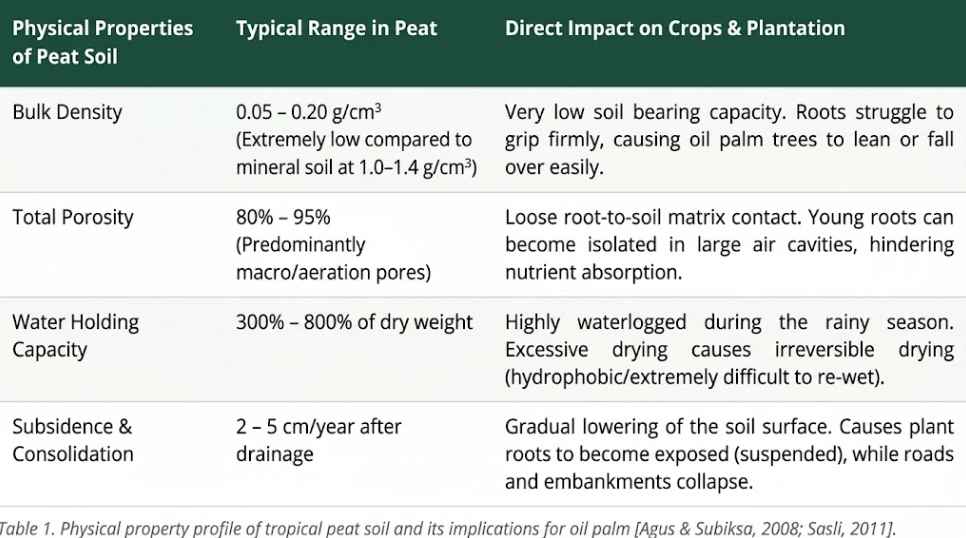
Physically, peat soil has a highly loose structure, very low bulk density, dominant macro-pores, and minimal mechanical bearing capacity. These conditions often cause growth problems in oil palm trees, such as leaning or uprooted palms, elevated root systems, and limited water and nutrient absorption due to excessively large air voids in the root zone [Sasli, 2011].
An effective and economical integrated approach to overcoming this is the utilization of boiler ash—the combustion residue of oil palm shells and fibers from palm oil mills (POM). As a mineral-rich waste, boiler ash functions as a physical and chemical ameliorant capable of filling peat macro-pores, raising soil pH, and providing macro and micro-nutrients [Anikwe, 2021; Ezema et al., 2021].
2. Physical Characteristics and Problems of Peat Soil
Peat soil possesses unique physical characteristics that pose major obstacles in the land clearing and management of oil palm plantations. Table 1 summarizes the range of tropical peat physical properties and their impact on oil palm growth in the field.
Two Most Critical Field Problems:
a. Leaning Palms: This mechanical instability causes young to mature oil palms to tilt or fall easily due to the weight of the canopy and fresh fruit bunches (FFB), as well as wind exposure.
b. Irreversible Drying: Peat that dries beyond its critical moisture limit permanently loses its wettability. It becomes hydrophobic (water-repellent), resembling dry sawdust that is highly flammable and struggles to absorb water again.
3. Physical and Chemical Characteristics of Boiler Ash
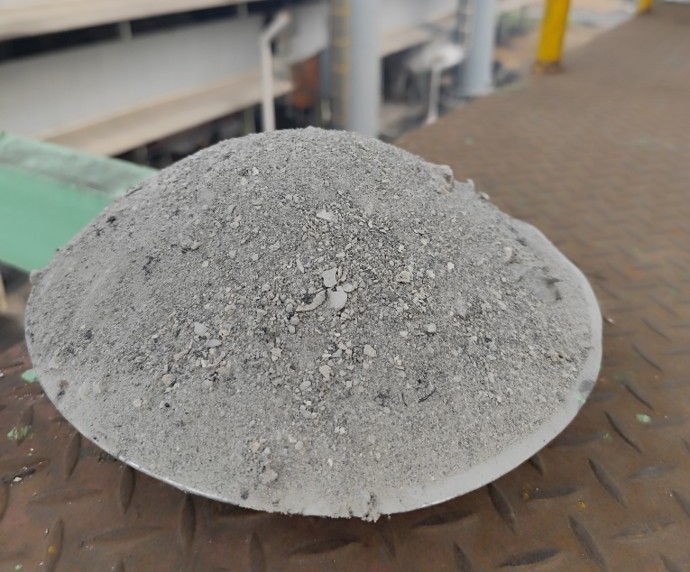
Boiler ash is a solid mineral residue resulting from the combustion of palm shells and fibers in the steam boilers of palm oil mills at temperatures ranging from 600–800°C. This byproduct consists of fine to medium granules, ranging in color from whitish-gray to blackish.
Physically, boiler ash has a much higher density than peat, around 0.35–0.65 g/cm³. Chemically, boiler ash is highly alkaline (pH 8.5–10.5) because it is rich in mineral oxides and exchangeable bases.
a. Silica (SiO₂): The dominant component (30–60%) that provides a solid mineral physical structure and helps strengthen plant cells.
b. Potassium (K₂O): Contains 4.0–8.0% K₂O, making it a highly potential organic potassium fertilizer source to partially replace MOP/KCl fertilizers.
c. Calcium & Magnesium (CaO & MgO): Calcium oxide (CaO 3–7%) and magnesium oxide (MgO 2–5%) act as effective liming materials to increase peat pH.
d. Phosphorus & Micro-nutrients: Contains P₂O₅ (1–3%) and trace amounts of micro-nutrients such as Iron (Fe), Manganese (Mn), Zinc (Zn), Copper (Cu), and Boron (B) [Ezema et al., 2021].
4. Mechanisms of Boiler Ash in Improving Peat Structure
Adding boiler ash to peat soil works by introducing high-density mineral fractions into the highly porous organic matrix. The improvement mechanisms include the following aspects:
a. Increasing Bulk Density: Fine boiler ash particles fill the macro-pores (excessively large aeration pores) in peat soil. This addition of mineral mass directly increases the soil bulk density per unit volume in the planting hole excavation zone, making the soil denser and more stable.
b. Increasing Bearing Capacity: The mixture of peat soil and boiler ash has a much higher shear strength than pure peat. This provides a significantly stronger mechanical foundation for oil palm roots to support the plant's vegetative and generative weight.
c. Improving Root-to-Soil Contact: A denser excavated media structure minimizes the presence of empty air voids around young roots. Tight contact between root hairs and soil particles accelerates water and nutrient absorption from the moment seedlings are transferred from the main nursery to the field.
d. Balancing Water and Air Pore Distribution: By reducing the excessive portion of macro-pores, the proportion of capillary pores that store water increases proportionally. This minimizes the risk of extreme drying in the shallow root zone.
5. Agronomic Benefits and Plantation Management
The application of boiler ash provides dual benefits for plant productivity and plantation operational efficiency:
a. Sturdier Plant Stands: Oil palm stands become more upright and sturdy, reducing the percentage of leaning plants by >60% in the first 3 years of planting.
b. Optimal Root Development: The penetration of lateral and anchorage roots develops more optimally due to the dense planting medium rich in calcium and potassium.
c. Increased pH & Nutrient Availability: The alkaline nature of boiler ash raises peat pH from extreme acidity (pH 3.0–4.0) to a more neutral level (pH 4.5–5.5). This neutralizes toxic organic acids (fulvic and humic acids) and increases the availability of P and K [Septiawan, 2024; Nadia, 2026].
d. Potassium Fertilizer Substitution: Replaces a portion of MOP (KCl) fertilizer needs. Applying 3 kg of boiler ash per planting hole can supply about 120–240 g of K₂O, equivalent to 200–400 g of MOP fertilizer.
e. Waste Cost Efficiency: Recycles POM byproducts in a circular manner (zero-waste concept), reducing ash waste accumulation around the mill while cutting external ameliorant purchasing costs [Veranika et al., 2018].
6. Technical Recommendations and Application Procedures
To achieve optimal physical and chemical structural benefits without causing salinity side effects or extreme pH spikes, the following application procedures must be implemented:
Field Reference Dosage:
The standard recommended dosage is 3 kg of boiler ash per planting hole (ranging from 2–5 kg/planting hole, or about 3–6 tons/ha). This dosage is adjusted based on peat maturity and initial soil pH.
Planting Application Procedure Steps:
a. Preparation of Planting Hole: Dig a standard planting hole (e.g., 60 cm x 60 cm x 50 cm). Separate the excavated topsoil and subsoil peat.
b. In-Situ Mixing: Evenly mix 3 kg of boiler ash with the excavated peat soil before returning it to the hole.
c. Prohibition of Concentrated Piling: DO NOT pile pure, concentrated boiler ash at the bottom of the planting hole or apply it directly against seedling roots, as this can cause osmotic shock/burn to young roots.
d. Backfilling & Compaction: Place a portion of the mixture into the bottom of the hole, compact gently, then place the oil palm seedling from the polybag. Fill the remaining soil-ash mixture around the root ball and compact until stable.
e. Fertilizer Adjustment: Reduce the initial MOP/KCl fertilization dosage for immature plants (TBM) by 25–50% in the first year due to adequate potassium supply from the ash.
7. Risk Analysis and Mitigation Measures
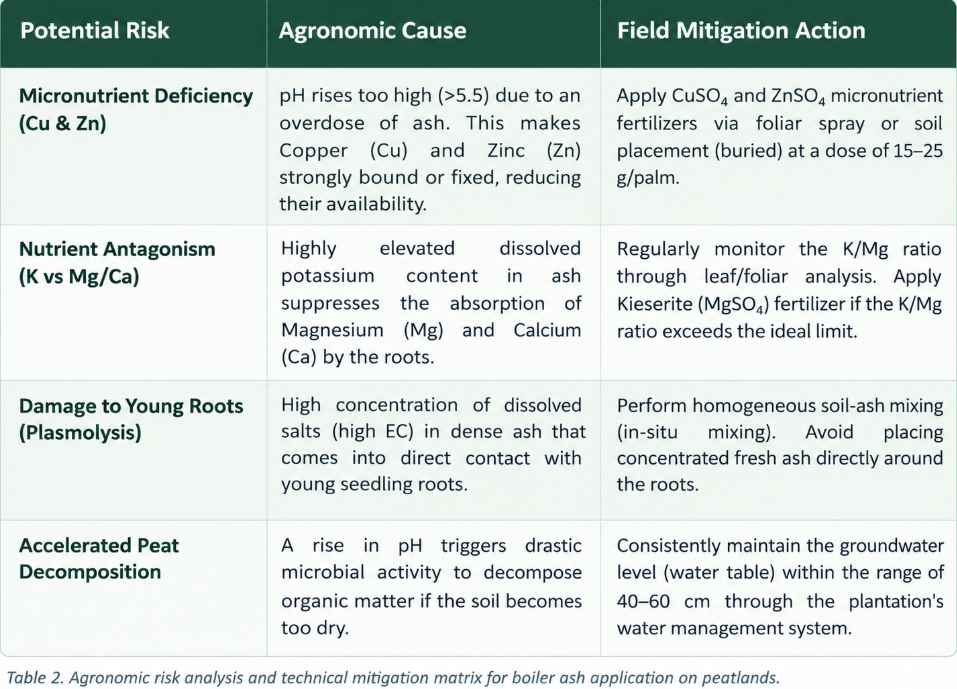
Despite its immense benefits, applying boiler ash in excessive doses or using improper techniques carries several agronomic risks. Table 2 details the risk analysis and mitigation schemes.
8. Conclusion
Boiler ash from Palm Oil Mills is a highly effective physical and chemical ameliorant for repairing peat soils in oil palm plantations. The measured use of boiler ash significantly increases bulk density and soil bearing capacity in the root zone, strengthens plant stands, minimizes the risk of leaning palms, and provides a substantial supply of potassium, calcium, and magnesium.
A reference dosage of 3 kg per planting hole (range 2–5 kg/hole) has proven safe and effective when mixed evenly with excavated soil. Boiler ash functions as a root zone conditioner but does not replace the vital role of water management. Controlling the groundwater level (40–60 cm) remains an absolute requirement to prevent macro-subsidence and irreversible drying in peatlands.
9. References
-
Agus, F., & Subiksa, I. G. M. (2008). Lahan Gambut: Potensi untuk Pertanian dan Aspek Lingkungan. Balai Penelitian Tanah dan World Agroforestry Centre (ICRAF), Bogor, Indonesia.
-
Anikwe, E. R. (2021). Agronomic Potentials of Boiler Ash Derived from Oil Palm Wastes as Fertilizer, Soil Amendment, and Liming Materials. Journal of Soil Science and Environmental Management, 12(2), 45-56.
-
Ezema, C. O., Nnaji, G. U., & Mbagwu, J. S. C. (2021). Effects of palm oil mill boiler ash on soil chemical properties and growth parameters of crops. Agro-Science, 20(1), 30-37.
-
Nadia. (2026). Aplikasi Abu Boiler Kelapa Sawit pada Tanah Gambut terhadap pH dan Ketersediaan Ca. Skripsi, Jurusan Agroekoteknologi, Fakultas Pertanian, Universitas Lambung Mangkurat, Banjarbaru.
-
Sasli, I. (2011). Karakteristik Gambut dengan Berbagai Bahan Amelioran dan Pengaruhnya terhadap Sifat Fisik dan Kimia Guna Mendukung Produktivitas Lahan Gambut. Jurnal Agrovigor, 4(1), 42-50.
-
Septiawan, A. (2024). Pengaruh Aplikasi Abu Boiler pada Nilai pH Tanah di Areal Gambut Kelapa Sawit (Elaeis guineensis Jacq.). Laporan Penelitian, Institut Pertanian Bogor (IPB University), Bogor.
-
Veranika, Nelvia, & Amri, A. I. (2018). Pengaruh Kompos Tandan Kosong Kelapa Sawit dan Abu Boiler di Lahan Gambut Terhadap Pertumbuhan dan Produksi Semangka (Citrullus lanatus). Jurnal Dinamika Pertanian, 34(1), 11-18.